Early History, Tragedy, & Rebirth
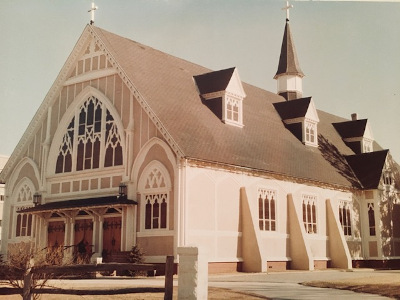 In 1895, the small town of Sayville—more a resort town than a year-round community—was in need of a Catholic church. Until that time, the Catholic population had traveled to St. Francis de Sales Church in Patchogue by horse and buggy, and by railroad handcar, to attend Sunday Mass.
With the arrival of Father Thomas Duhigg in the spring of 1895, St. Lawrence the Martyr found a temporary home at the Old Methodist Episcopal Society Building. Father Duhigg, a man of only 32, found no church, no rectory, and very few parishioners. But those who did attend that first Mass on June 2, 1895, in a building rented for $25 a month, were the seed of what would become a robust community of faith.
In June, 1896, construction of the church began on property at the southeast corner of Handsome Avenue and Main Street, which had been purchased for $4,250. The building contract went to A. M. Gatchell of Newark, New Jersey, because he was the only contractor whose price fell beneath the $10,000 limit set by the Bishop. This was a huge financial obligation for the parishioners, considering that the average weekly collection was only $30 at the time! But on October 11, 1896, St. Lawrence's permanent spiritual home was dedicated. And in 1898, Father Duhigg built a rectory on the same plot of land, just west of the church. He had been renting rooms in various homes in Sayville, but when a mysterious fire caused $3,000 in damage and nearly destroyed the church, Father Duhigg felt that he needed a closer residence.
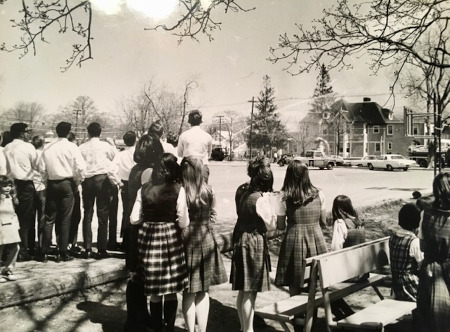 On Tuesday, April 25, 1967 at 10:58 AM, a sudden flash fire broke out and completely destroyed the church, which by then had become a Sayville landmark. The entire 120 by 40 foot edifice was engulfed in flames that could be seen for miles. But the burning church was only one problem: about 30 feet east of the church was St. Lawrence the Martyr parochial school, with 700 children attending classes inside. All the children were evacuated safely from the school as soon as the alarm sounded. About 10 feet west of the church was the three story, stucco and wood rectory, which the fire department managed to save. The church, however, was entirely lost.
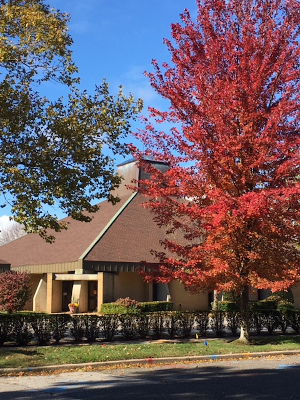
Needless to say, a deeply shaken community was eager to rebuild after the catastrophic fire, and on April 20, 1969, construction of the new church began. The new church was designed by Dobiecki and Beattie Architecture Firm, and built by J. F. O'Healy Construction Company of nearby Bayport. A distinctly modern building with a very large, open interior, the new church was entirely different from the small Victorian-style building that parishioners had known for 69 years. In keeping with dramatic changes in the Church’s liturgical norms, the altar was placed in the center of the sanctuary. Gone was the altar rail, and with it a sense of separation between the congregation and the liturgical action taking place in the sanctuary. The building was dedicated on Sunday, October 25, 1970, a grand liturgical celebration presided over by Bishop Walter P. Kellenberg, the first Bishop of Rockville Centre. Currently, the campus of St. Lawrence the Martyr parish occupies 6.5 acres on Montauk Highway, intersected by Handsome Avenue. The acreage is the result of stitching together six different parcels of property acquired by the parish over a 72-year period.
 This very brief sketch of building and rebuilding can’t begin to describe how the community that has occupied these structures has grown and flourished for almost 130 years. The parish of St. Lawrence the Martyr is far more than an edifice, no matter how beautiful. We are the People of God, striving to provide a spiritual home for some 3,800 families. The community has witnessed all the challenges and joys, the heartache and promise of any thriving Catholic parish, and continues to invite its members to enter deeply into the Christian life—by joining together in spirited worship, by passing the treasure of our faith on to the next generation of believers, by practicing the tangible love of neighbor that is central to Jesus’ teaching, and by living squarely in the virtue of hope. May the early history of this unique faith family be only a brief—but precious—preamble to all that God still holds in store!
A special word of thanks goes to Mr. Christopher Koch for assembling much of the information contained in this piece.